The Real Cost of Manual Operations Isn’t What You Think It Is

H M Husnain
April 20, 2026 · 4 min read
In this article
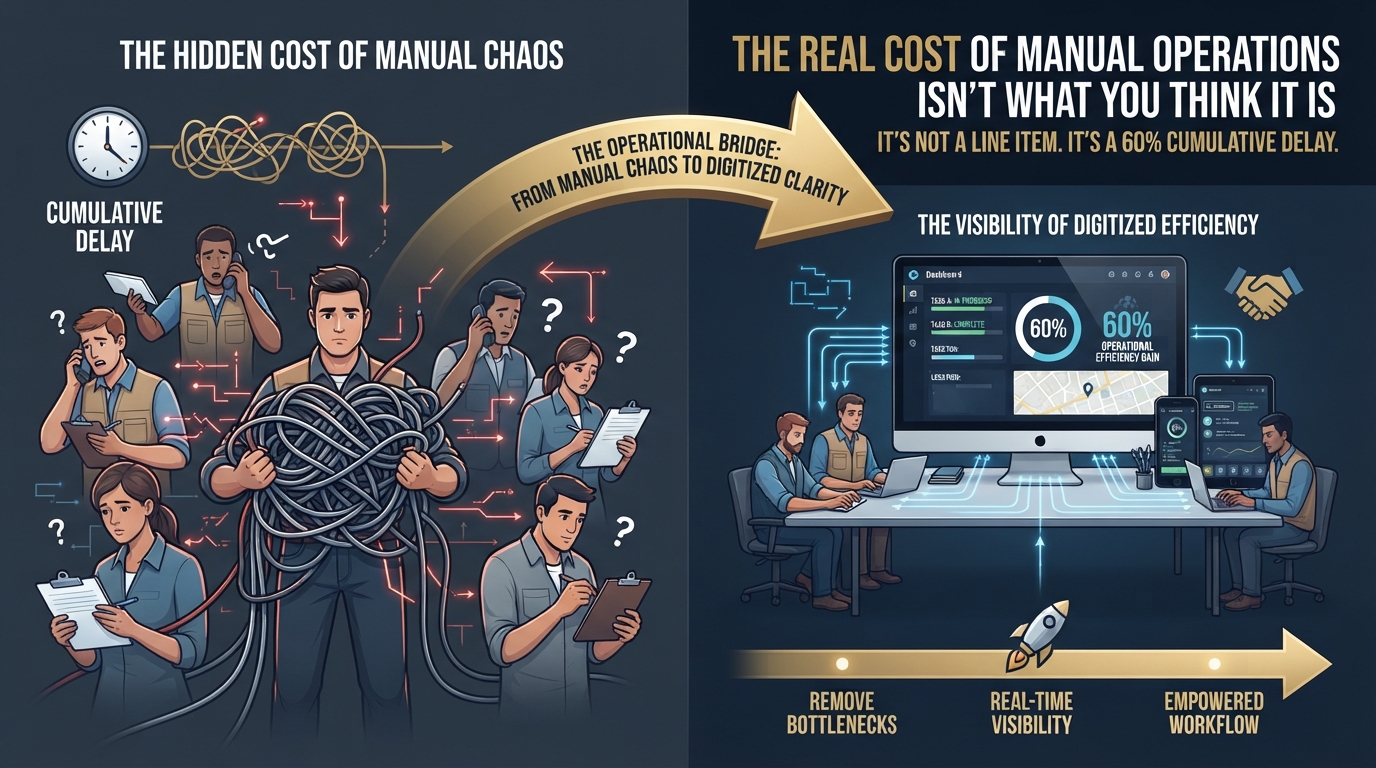
When a business is running on manual coordination, phone calls, spreadsheets, someone physically checking on something, the cost of that usually doesn't show up as a single line item anywhere. It shows up as delay, spread across dozens of small moments a day that everyone's simply learned to accept as normal.
The 60% number, and where it actually came from
On one engagement, enabling a business to manage field operations remotely and in real time, built with React Native and Node.js, cut operational delays by 60%. That number didn't come from a single dramatic fix. It came from replacing a pattern where information had to travel through people, someone calls, someone checks, someone reports back, with a system where the current state of an operation was just visible, immediately, to whoever needed it.
Why this is easy to underestimate
Manual coordination costs are invisible precisely because they're distributed. Nobody experiences the full 60% delay at once, it's a few minutes here, a phone call there, a decision made on information that was already an hour stale. Add it up across a team and a week, and it's a meaningful chunk of operational capacity, but it never appears as a single, obvious problem someone would flag, because it's just "how things work."
What actually moves the number
Good architecture in this kind of work isn't about more features, it's specifically about removing bottlenecks, the points in a process where a person is forced to wait on another person instead of on the work itself. That's a different design question than "what should this app do." It's closer to: where, exactly, is time currently being lost, and what needs to be true for it not to be lost there anymore.
The takeaway for anyone still running manual
If a process depends on someone being available to relay information, that's not a minor inefficiency, it's a structural delay built into how the business operates, and it compounds every single day it's left in place. The businesses that get the most value out of digitizing operations aren't the ones chasing new features, they're the ones willing to look honestly at where their team is currently waiting on other people instead of on the work.
Working on something similar?
I take on a limited number of engagements at a time. If this resonates with a project you're planning, let's talk about it.
Get in Touch