Why I Don’t Give a Fixed Quote Before a Discovery Phase, and Why That’s Good for You

H M Husnain
April 26, 2026 · 4 min read
In this article
Clients asking for a fixed quote before any discovery has happened isn't being difficult. It's usually a sign they've been burned before by a vague scope that quietly ballooned into a much bigger bill than anyone agreed to at the start.
The instinct to avoid
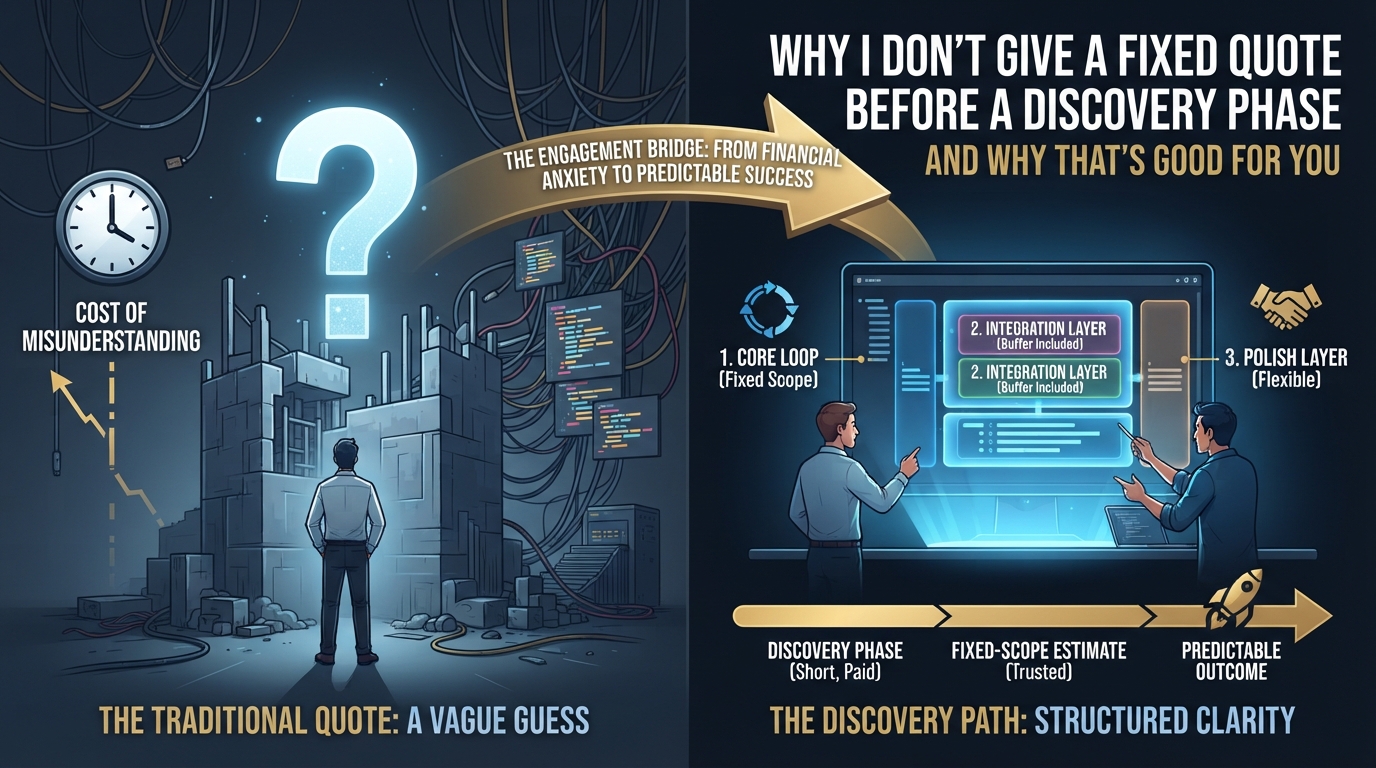
The wrong response to that request is refusing to quote anything until the client commits to an open-ended engagement. That just relocates the trust problem instead of solving it. The right response is structuring the engagement so the first paid step is a short, bounded discovery phase that produces a real, fixed-scope estimate, one both sides can actually hold each other to.
How I actually estimate, once discovery starts
I break every project into three layers. The first is the core loop, the minimum sequence of screens and actions that makes the product usable. That's what I estimate precisely, because the scope there is fixed and well understood by the time discovery is done. The second is the integration layer, auth, payments, third-party APIs, which almost always takes longer than it looks on paper. I build in roughly 30% buffer here, not as padding, but because integration surfaces are consistently where real surprises live. The third is the polish layer, animations, edge cases, performance tuning, which I scope last, and only after the first two layers are actually working, because you can't meaningfully polish something that isn't stable yet.
Why this matters more than the number itself
An estimate built this way isn't a guess dressed up as a number, it's a structured breakdown of where the uncertainty in a project actually lives. That distinction matters to clients more than the headline figure does, because it tells them what's solid and what still has some give in it, instead of one number that either turns out to be accurate by luck or wrong for reasons nobody can point to later.
What this means for you as a client
Clients aren't actually afraid of paying for good work. They're afraid of an open-ended bill with no end in sight, and a fixed number that turns out to mean nothing once real work starts. A short, paid discovery phase upfront costs less than either of those outcomes, and it's the reason the estimate that follows it is something I'm willing to commit to.
Working on something similar?
I take on a limited number of engagements at a time. If this resonates with a project you're planning, let's talk about it.
Get in Touch