Shipping an MVP in 45 Days: What Actually Gets Cut

H M Husnain
March 27, 2026 · 6 min read
In this article
A client came to me needing to go from idea to a working, production-ready MVP fast. Not "fast" in the loose sense founders often mean it, but a real 30-60 day window to get something in front of real users. The bottleneck for most startups in this position isn't technical capability, it's unclear scope stretching the timeline past the point where the MVP still matters.
Speed comes from architecture decisions, not shortcuts
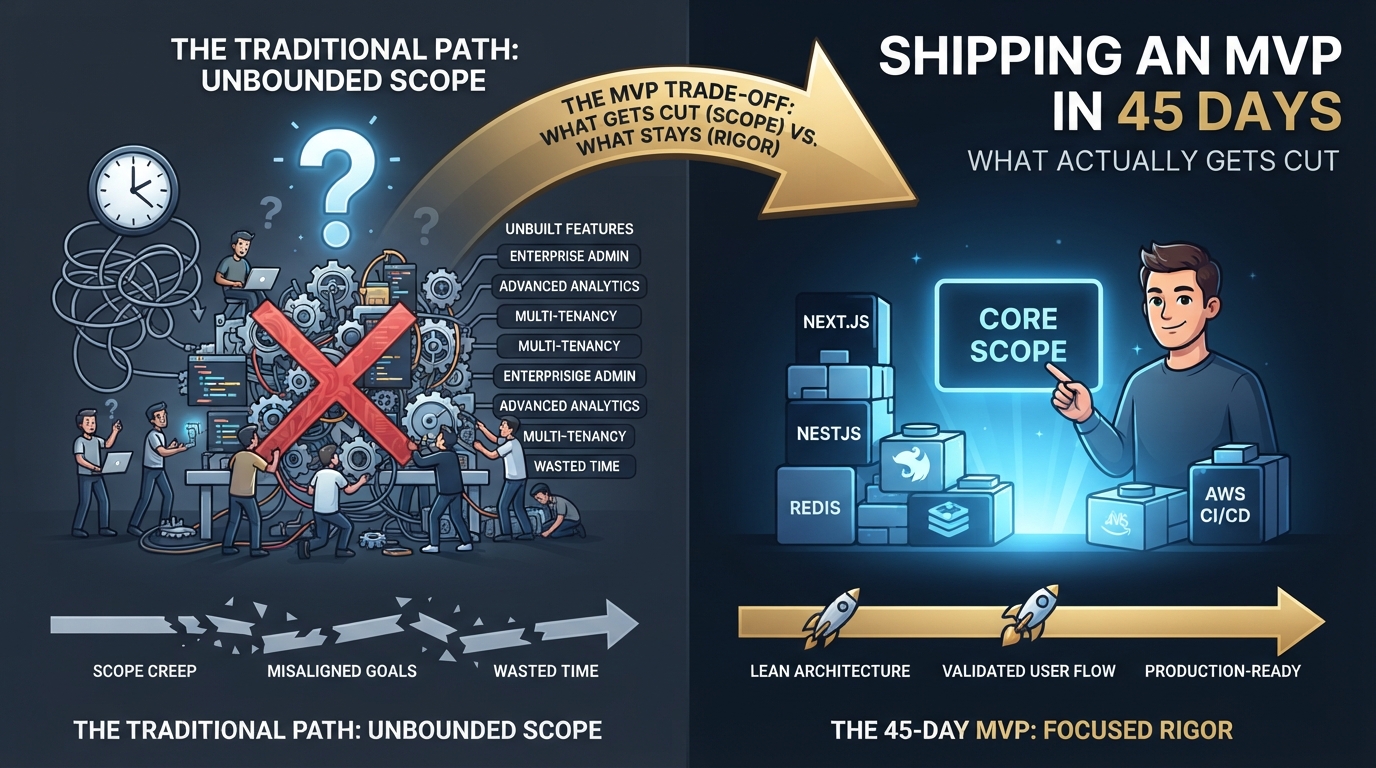
Shipping in 45 days doesn't mean cutting corners on the engineering itself, it means being deliberate about what the MVP actually needs to prove. I built the product on Next.js and NestJS, used Redis for caching where performance mattered most, and deployed on AWS with CI/CD in place from the start, so the "fast" version and the "real" version were the same codebase, not a prototype that would need to be rebuilt.
What the engagement actually involved
- Scoping a lean MVP architecture suited to an early-stage startup, not an enterprise system
- Building the full-stack SaaS application in Next.js and NestJS
- Implementing real-time, high-performance backend systems where the product needed them
- Tuning performance with caching and database optimization rather than over-provisioning
- Setting up AWS deployment with CI/CD pipelines from day one
- Working directly with the client's founding team to scope and continuously prioritize the build
Impact
MVP delivery time went from the months a from-scratch build often takes down to as little as 30-60 days, giving the client a production-ready product to validate with real users and iterate on based on actual market feedback, not assumptions.
What actually gets cut, and what doesn't
Scope gets cut. Engineering rigor doesn't. Clear scope upfront is what prevents over-engineering and delay, but the architecture still has to be built to hold up past day one, because a 45-day MVP that has to be rebuilt at 100 users didn't actually save anyone time. Clear, continuous communication with the founding team mattered as much as any technical decision, since the scope of an MVP shifts as real feedback comes in, and that only works if the client is part of that conversation throughout, not just at kickoff.
Working on something similar?
I take on a limited number of engagements at a time. If this resonates with a project you're planning, let's talk about it.
Get in Touch