The Unglamorous Work Behind a 99.9% Payment Success Rate

H M Husnain
April 2, 2026 · 5 min read
In this article
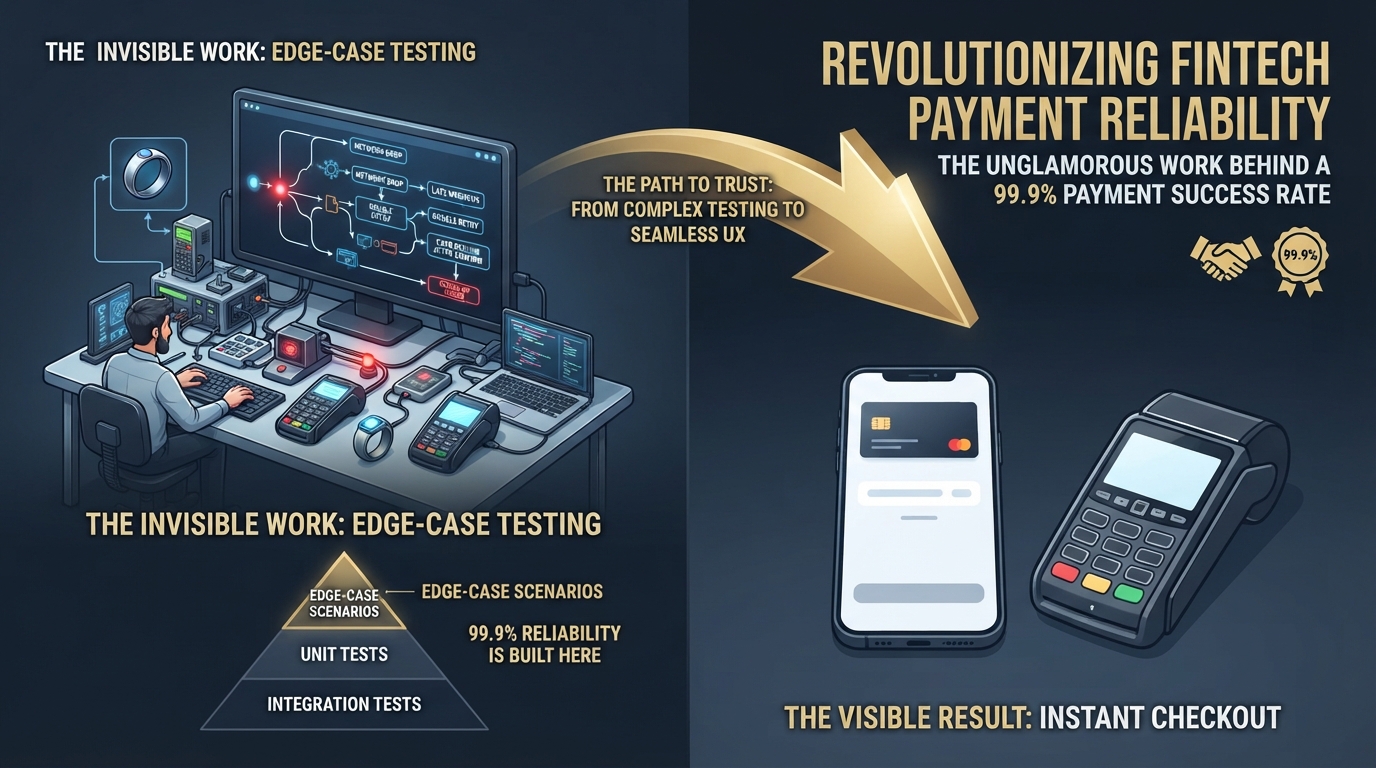
When people look at a payments product, they judge it on whether it worked. Nobody sees the edge cases that had to be closed off to get there. Building the real-time transaction flow for Monesave, a contactless wearable payment product, taught me how much of "it just works" is actually unglamorous, deliberate testing.
Reliability is a testing problem, not a features problem
A 99.9% payment success rate doesn't come from adding features. It comes from finding every way a transaction can fail, before a real user does. Network drops mid-tap, a card declining after the wearable already confirmed a gesture, a webhook arriving late, a retry firing twice, each of those is a distinct failure mode that needs its own handling, not a generic "something went wrong" catch-all.
Where the actual gains came from
The checkout flow itself went from roughly 45 seconds down to 8. That wasn't one clever trick, it was smarter state management and trimming unnecessary API round-trips, the kind of unglamorous work that never shows up in a demo but is the entire difference between a product that feels instant and one that feels like it's thinking.
What this generalizes to
Sometimes the biggest UX win in a product isn't a new feature at all, it's removing friction nobody had actually noticed was there until it was gone. And trustworthiness in a payments product isn't a marketing claim, it's the sum of every edge case someone bothered to test before it reached a user. That's not exciting work to talk about. It's the work that actually earns trust.
Working on something similar?
I take on a limited number of engagements at a time. If this resonates with a project you're planning, let's talk about it.
Get in Touch