Modernizing a Legacy System Without Stopping the Business

H M Husnain
June 7, 2026 · 5 min read
In this article
The hardest part of modernizing a legacy system usually isn't the technical migration itself. It's that the old system has to keep running the entire time you're replacing it, because the business depends on it every single day, and it doesn't get to pause for a rewrite.
Why a full stop-and-rebuild rarely works
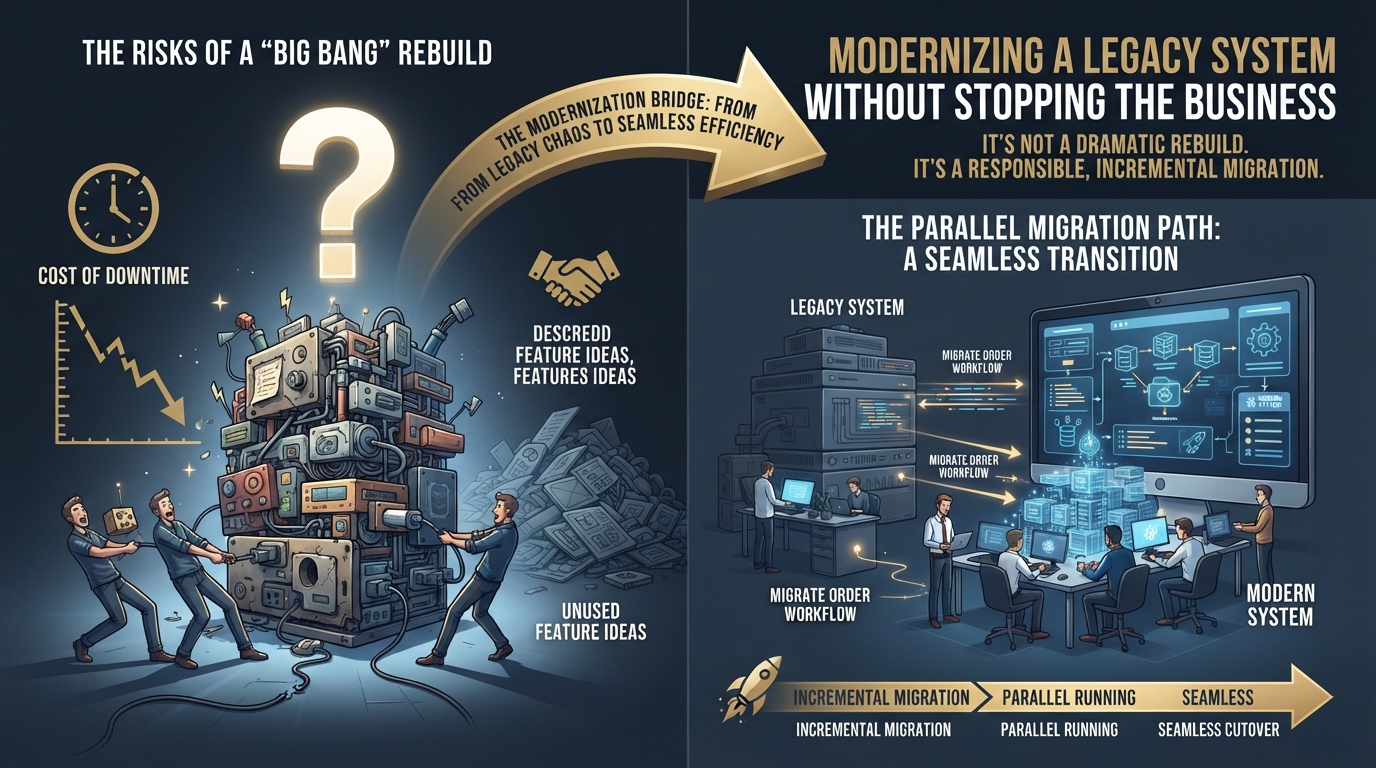
The instinct with a genuinely painful legacy system is to want to rip it out and start fresh. In practice, that approach carries enormous risk: months of work with nothing shipping, a single high-stakes cutover day where everything has to work perfectly, and no real way to validate the new system against real usage before it's the only system left standing.
The approach I'd actually take
Run the two systems in parallel wherever possible, rather than a single cutover. Migrate one workflow or one user group at a time, not the whole system at once. Keep the ability to roll back at every stage, not just as a theoretical safety net but as something genuinely exercised early, so you know it actually works before you need it under pressure. Treat data migration as its own project with its own validation step, since a legacy system's data is rarely as clean as anyone assumes, and discovering that mid-migration is far worse than discovering it before.
What tends to go wrong
The most common failure mode isn't a technical one, it's underestimating how much implicit business logic is buried in the old system, logic nobody wrote down because it was never meant to be read, just executed. A field that's unused for most records but critical for one edge case. A workaround someone built years ago that quietly became load-bearing. Finding these before they cause a production incident is most of the actual work.
The real measure of success
A modernization project succeeds when nobody outside the team notices it happened, no missed orders, no confused customers, no fire drill. That's a much less exciting story to tell than a dramatic rebuild, but it's the actual bar for doing this kind of work responsibly on a system a business depends on.
Working on something similar?
I take on a limited number of engagements at a time. If this resonates with a project you're planning, let's talk about it.
Get in Touch