What Building a Wearable Payments Platform Taught Me About Fintech Architecture

H M Husnain
January 20, 2026 · 7 min read
In this article
When I joined the team building Monesave, a wearable payments product that lets people pay contactless through a smart ring, the brief sounded simple: make payments faster. In practice, "faster" meant rethinking the whole transaction pipeline, not just shaving milliseconds off an API call.
The problem was never speed, it was trust
Cutting checkout time from around 45 seconds down to 8 required more than a snappy frontend. Every shortcut we could take on the user-facing side had to be matched by extra rigor on the backend, because we were compressing the window where fraud checks, balance verification, and transaction logging all had to happen.
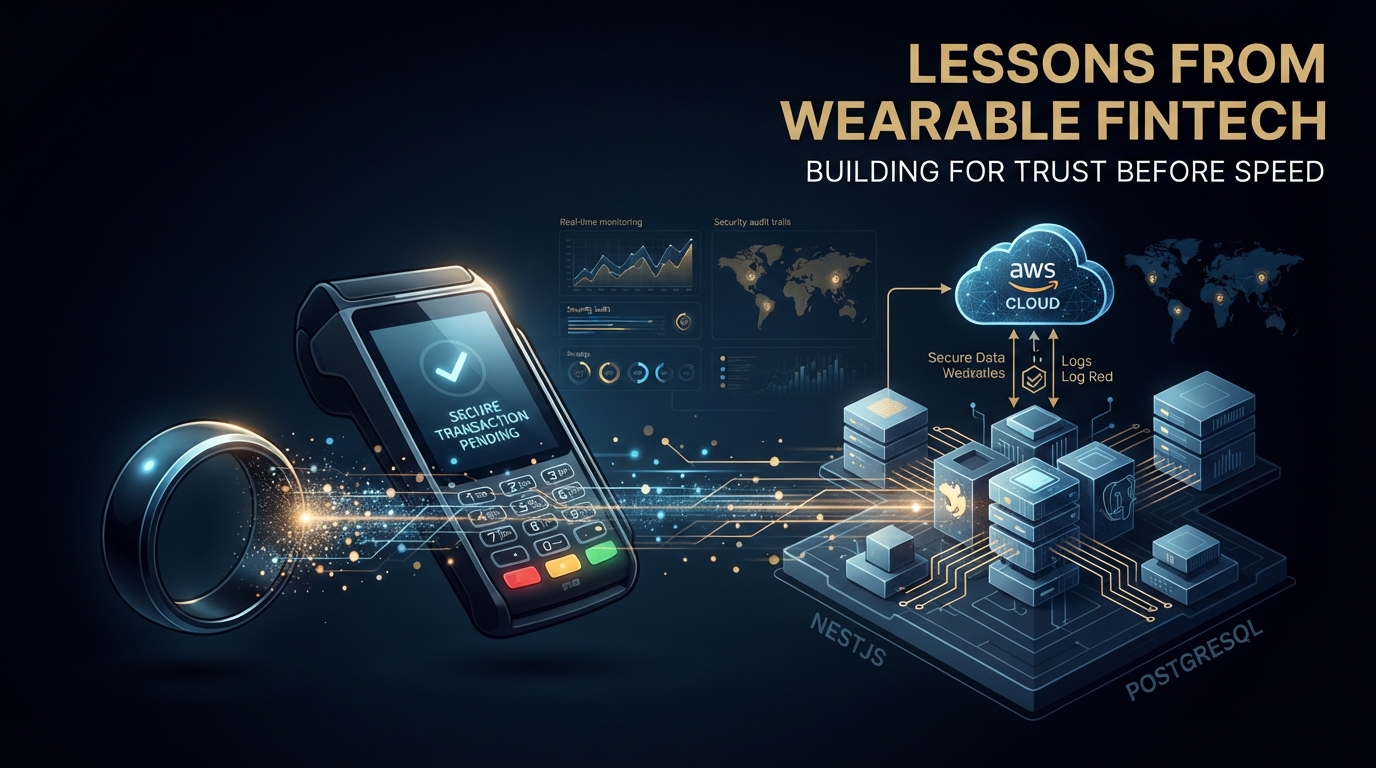
We ended up building the transaction engine with NestJS, backed by PostgreSQL for auditable, transaction-safe records, with AWS handling the scaling and failover. None of that is exotic technology. What mattered was the order we built things in.
Security first, features second
In most product builds, you sketch the happy path first and bolt on edge cases later. Fintech doesn't let you do that. We spent real time upfront on PCI compliance and failure modes before writing a single payment flow screen, because retrofitting security into a live payments system is far more expensive than designing for it from day one.
What actually moved the needle
- A real-time processing engine that could confirm a transaction without waiting on slower downstream checks
- A database schema built around auditability first, performance second, since every transaction has to be traceable
- Monitoring and alerting that caught payment failures before customers did
The lesson for any high-stakes product
Whether it's payments, healthcare data, or anything where a bug has real consequences, the pattern is the same: build the boring, unglamorous safety net before you build the exciting part. The system now processes millions of dollars a year at 99.9% uptime, and that reliability is the actual product, even though customers only ever see the fast checkout.
Working on something similar?
I take on a limited number of engagements at a time. If this resonates with a project you're planning, let's talk about it.
Get in Touch